milsiz is where the work of independent and rising artists doesn't sit gathering dust in the studio. A hybrid art marketplace and distributed exhibition network that picks up the art galleries and labels leave behind and carries it into real rooms — cafés, bars, public squares.
The walls and the speakers have their ears open. No gallery, no label — just a wall to hang your work, a speaker to play it, and a room that listens to you.
milsiz does two things at once: it hangs visual work on the walls of venues and plays music on their radios. Artist and venue are equals; milsiz records whatever the two of them work out — it never dictates the splits.
What we bring together
The people, places and works milsiz connects — and the channels through which they meet. Each channel does something: it integrates, activates, expresses, tells, or settles. Underneath all of it, one constant — the artist comes first.
integrateTwo people meet in a single word — a collaboration, a commission. The terms are talked through from the first step; the trust is on paper before anything begins.
activateWork comes alive in a room — a track spinning on the venue's radio, a list a curator strung together. Sound keeps the room breathing.
expressWork shows itself where people already are — on a wall, in the flow of discovery; never behind a gate. And anyone can make a wish — the simplest, most human gesture on milsiz.
tellThe map and the streets tell you where art is breathing — a city, read room by room, wall by wall.
settleA sale closes itself and splits itself — money waits in escrow, then lands with the artist and the venue, down to the cent.
emphasizeThose bold black dots are the invisible thread holding it all together — milsiz. The thickest one always reaches the artist: they come first.
Philosophy & principles
Our one north star: an economy where art stays in the hands of whoever made it.
What we believe
The artist comes first. We take %0 commission on tips; on a sale the artist gets the full listed price, and the buyer covers the platform fee at checkout.
We're the broker, not the boss. Venue commission, duration, logistics — all of it is talked through between the two sides. We don't rule on it; we record what's agreed and hold everyone to it.
No gallery, no label. We don't stand a gatekeeper in the way — we put up walls, speakers and neighbourhoods.
Art isn't served, it's stumbled upon. A feed doesn't “serve” you work; you run into it in a room, with a song playing, next to someone who has something to say about it.
Local and physical. The network stands on real venues — art becomes part of a place, not a tile on a profile.
We didn't make this up from scratch. We come out of a long tradition that puts the independent artist at the centre and shares ownership and decisions with whoever makes the work. What we're doing is carrying that model somewhere it hasn't reached yet — art that's gone out onto the street.
How it works
Four humans, one network: the artist, the venue, the curator and the collector.
The artist uploads their work — a piece or a track — and picks its status: draft, on show (visible but not for sale), or for sale.
The venue confirms its spot on the map, opens applications, builds shows, and puts its own radio on air.
The two shake on a collab: where the work hangs or plays, the commission, the duration, the logistics. milsiz handles the checkout, the payout split and, if needed, the logistics; the moment a sale lands, it divides the shares on its own.
The collector discovers by wandering — not in a feed, but in a venue, on a street. They like it, pin a mood to it, leave a tip, or buy.
Human
Human: anyone who drops by milsiz.art. Artist, collector, venue owner, curator, or just someone wandering through — every one of them is a “human”.
We don't say “user”. Because what happens here isn't consuming a product; it's looking at a work, hearing a room, leaving a thought on your way past.
The roles — artist, collector, venue, curator — say what a human is doing right now, not who they are. One human can wear several roles at once: selling in the morning, collecting at night.
Street
Street: a slice of milsiz's walkable world — a crossing where venues become buildings and works become walls. A neighbourhood, not a feed.
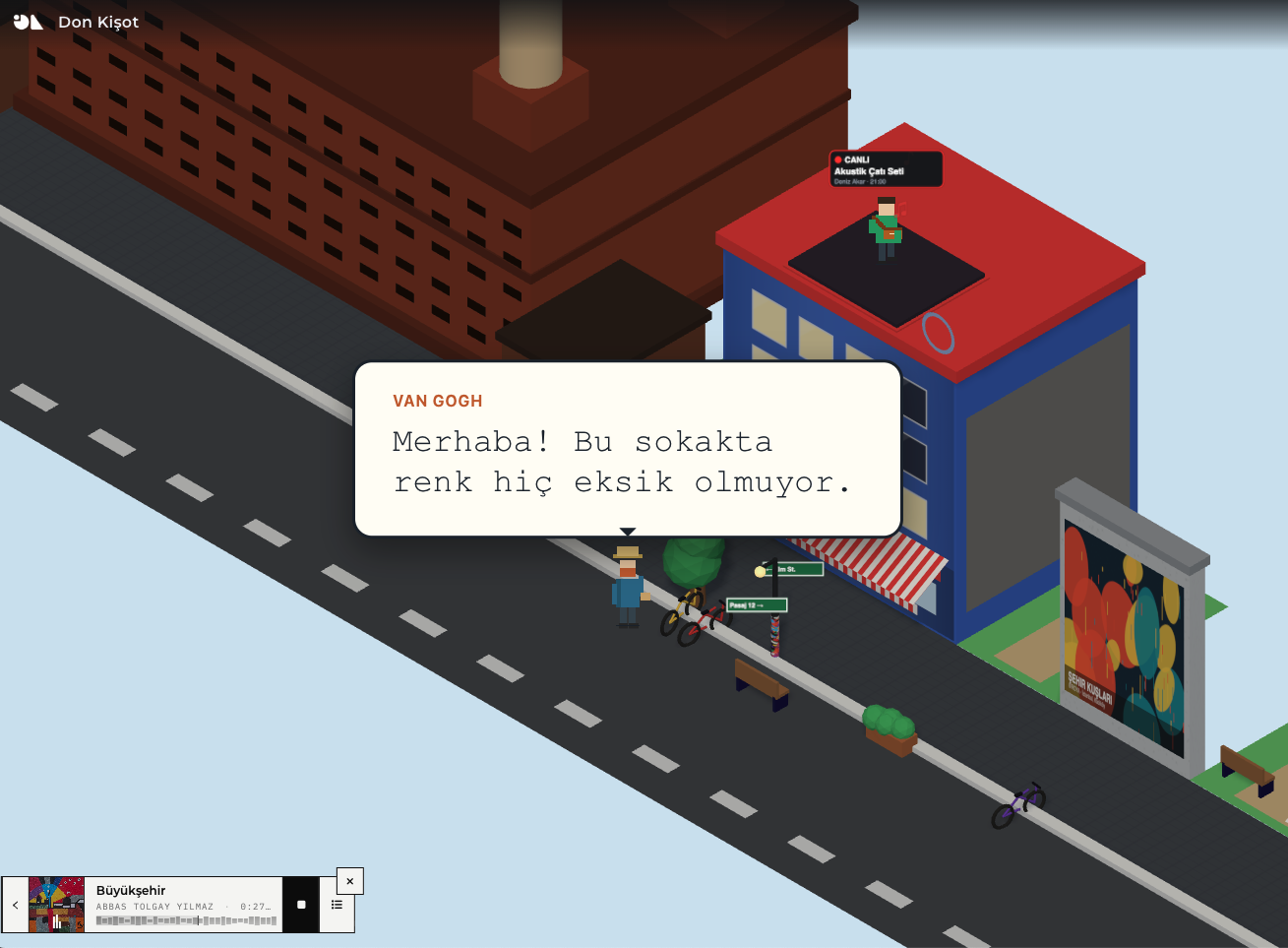
You walk down a street, run your eye over the work on the walls, duck into a café and hear what's playing right then. Every building is a real venue, every wall holds real work. Streets open onto one another through portals — Don Quixote, Elm, Pera; each with its own air, its own smell.
The street turns milsiz into a place: it gives back lingering, stumbling-upon, context. A work says far more when you run into it in a room, with a song playing, beside someone who has a thought about it.
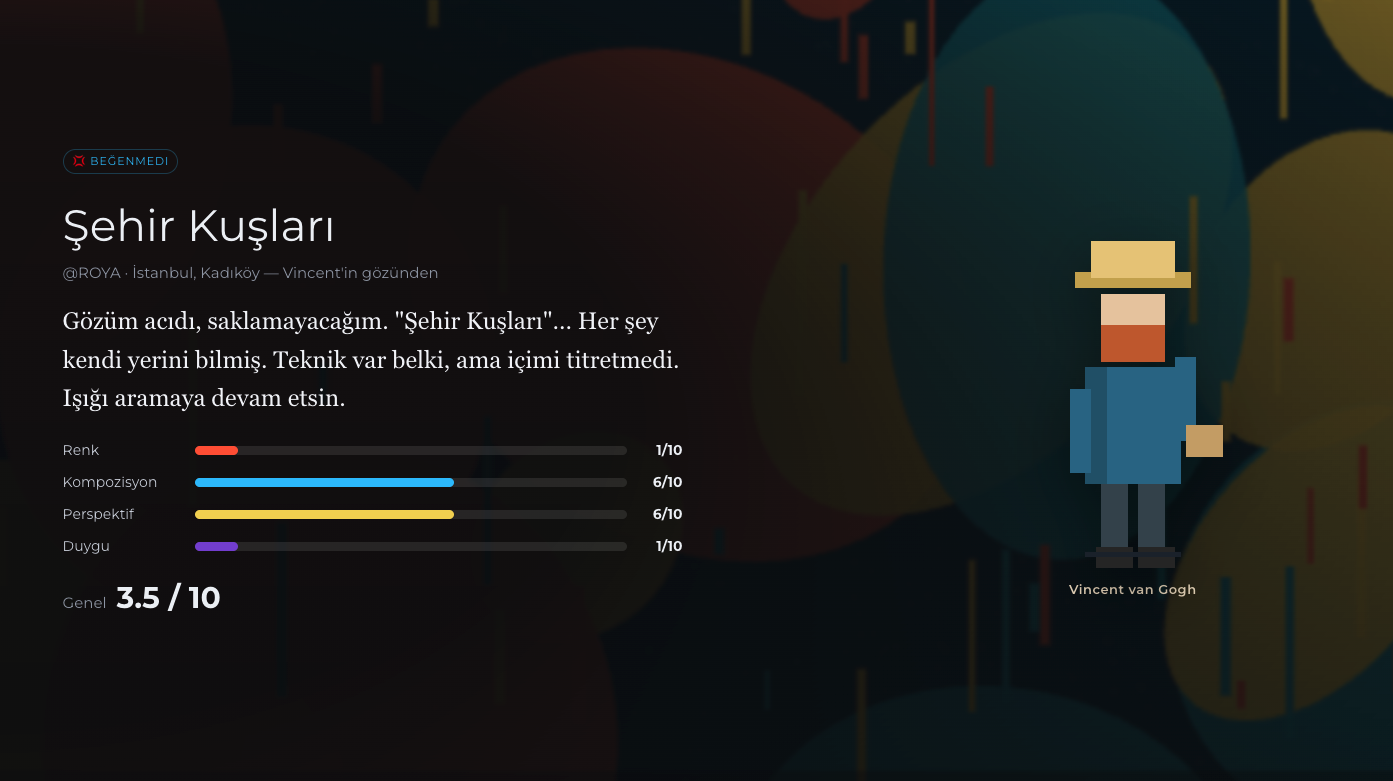
Resident: Every street has a resident — a character who roams it, greets you, and critiques a work through their own eyes when you click it. Don Quixote's resident is Vincent van Gogh; Elm's is Karl Marx, Pera's is Sherlock Holmes, and Özgürlük's is Mustafa Kemal Atatürk. Each resident's eye catches on something different: one on colour and feeling, one on class and labour, one on a clue, one on civilisation.
Vincent van Gogh, the resident of Don Quixote, greets you on the street.The resident critiques the work through their own eyes — scoring it on colour, composition, perspective and feeling.
Venue
Venue: the physical place where works hang and performances happen — café, bar, gallery, hall, lobby. A point on the map; the moment its owner confirms it, it becomes a “venue”.
A venue has two things in hand: a wall and a speaker. It runs shows on its wall and plays its own radio through its speaker. It designs its own page, opens and closes applications, and builds shows.
The room is already a programme in itself. milsiz hands the venue the console that runs it.
Work
Work: a visual piece. Its status tells its life story — draft, on show (visible but not for sale), for sale (buy now), sold.
Rarity: unique, edition, or open. Alongside the original, on-demand variants — prints, stickers, run off as the demand comes in — can be defined.
A work's ownership history is on record; each time it changes hands, another link is added to the chain. A work can carry a “soundtrack” — tracks the curator picked. A work can come from one hand (solo) or many (collab).
Music
Music: a track. The community uploads it or the platform hosts it. Status: draft, live, awaiting radio approval, radio-ready.
The licence is as open as the artist cares to open it: from “all rights reserved” to a range of Creative Commons options. The credits (whoever put in the work), links, genres and the venues it was born in — all of it travels with the track.
A track enters a venue's library or playlist only with the permission of an active collab.
Show
Show: a selection at a venue — dated if you want. It can be offline (in a physical venue) or online (at a URL).
A show either keeps to the venue's opening hours or sets its own dates. Artists put their work up for a show by application; the venue or curator takes it in or turns it away. Once applications close, no new work gets in.
Radio
Radio: the unbroken broadcast of the tracks a venue has queued. The moment the venue takes it “on air”, it opens to listeners.
One broadcast, one shared ear: everyone hears the same thing at the same time. Step into a venue on the street and you hear, live, exactly what it's playing right then — whatever the room is playing, the street is too.
Curation & curators
Curation: a carefully chosen collection — works, artists, venues or shows. It can be the picks on the homepage (system curation) or tied to a single show.
A curator picks, puts in order and ties it to a purpose (the homepage, say). A curator who builds a good show takes a share of the sales it brings in — so good curation pays off, and a self-sustaining loop keeps turning.
Mood
Mood: an emotion tag the community pins on — “melancholic”, “hopeful”, or an emoji. You fix to a work or track the mark it left in you.
A mood is neither a star nor a score. It doesn't measure a work; it tells how it touched you. Anyone can leave at most a few moods on a work; a mood can belong to a single language (tr/en) or be universal, beyond language.
Tip
Tip: support left for an artist, expecting nothing whatsoever in return.
We take no commission — the whole tip (minus only payment and currency costs) goes to the artist. A tip is the money form of “this one got to me”: a way to stand behind a work without buying it.
Venue ↔ artist collaboration
The most common collab: an artist offers their work to a venue, or a venue asks an artist for work. It might be a visual piece, a track, or something new — a commission.
The agreement spells out the venue's commission (%), the minimum run, the notice period, and who handles logistics — does the artist ship, does the venue, or is it pickup on site.
For music it also fixes the licence scope: does the track only show on the venue's page, can it join playlists, can it play in the room, can it air on milsiz radio.
No venue, no commission: a joint-production agreement between two artists — more, in time. It can be music, visual, mixed, or still open.
It names each participant's role — co-creator, feature, producer, writer, visual — and optional revenue splits (%, adding up to 100). Once everyone accepts, the collab turns “active”; the works and tracks it yields gather as outputs.
Through the minimum run (say 90 days) it can only end by mutual consent. After that, either side can step away on notice — say 30 days.
The point is to protect both sides: the artist isn't taken off the wall overnight, and the venue isn't tied down forever. milsiz doesn't impose the terms — the two sides talk, milsiz records and enforces them.
Collaboration examples
Sample documents that show what a real collaboration agreement looks like — the very one you'd download from the collabs page, just filled in with example parties.
The documents carry an “ÖRNEK · EXAMPLE” watermark and aren't binding; they're only here to show the format and the clauses it covers.
Direct sale (no venue): the lion's share is the artist's; the buyer covers the platform fee at checkout.
Show sale (through a venue/curator): first the platform, venue (the rate agreed in the collab) and curator shares come out; the rest is the artist's.
milsiz doesn't set the rate on its own; the venue commission is talked through afresh in each collab. The cost of the infrastructure comes out of the platform's share — it's never loaded onto the artist's back.
Payments
The money flow is out in the open: the collector pays, the funds sit in escrow until delivery or pickup is confirmed, then the shares split on their own and pass to the artist and the venue.
milsiz is a technical intermediary — not a registrar. International payments run through a regulated institution. No upfront fee is asked of the artist; the only things talked through are the tip and the share on a sale.
milsiz.art uses a single cookie, milsiz_presence, set by app.milsiz.art when you sign in. It carries your display name, role, and avatar so this site can show your account menu. It is not analytics, not advertising, and not shared with anyone.